Editorial
DOI:
https://doi.org/10.65296/rrh.5.1.59Keywords:
editorialAbstract
The development of research on the sonic and musical arts in Peru remains an ongoing process and poses a significant challenge for institutions, researchers, and artists seeking to understand the complexity of our musical past and present—both near and distant, both our own and that which may be perceived as belonging to others. This challenge entails, on the one hand, continuing to build an informed mapping of our musical histories and, on the other, developing forms of scientific and artistic knowledge capable of critically engaging with the multiple dimensions of the sonic arts.
The extraordinary diversity of our musical practices, the richness of their traditions, and the many ways in which music participates in the construction of our cultural identities stand in contrast to the still insufficient number of spaces devoted to their study, documentation, critical discussion, and dissemination. This situation underscores the need to continue creating spaces for music research, not only as a means of preserving and understanding our knowledge and practices, but also as an opportunity to establish dialogues with other cultures and with the multiple musical phenomena that form part of our contemporary world. In a context in which the global and the local are undergoing continuous transformation, musics circulate, encounter one another, are incorporated into new settings, and acquire new meanings, giving rise to processes that need to be observed and understood from a multidisciplinary perspective and, in some cases, through a post-disciplinary liberation from conventional boundaries.
That said, the development of research cannot be conceived independently of the concrete conditions under which it takes place. Building research capacity is a gradual process closely linked to the institutional, academic, and cultural trajectories of each context. Any initiative aimed at strengthening research must therefore begin with a situated understanding of our current possibilities, acknowledging the paths already taken and, on that basis, identifying new avenues for development.
The works brought together in this issue reflect precisely this diversity of approaches and represent a range of national contexts within music research. Across these pages, readers will encounter studies ranging from the history of jazz in Peru and the instrumental practices and formats of Huánuco’s musical tradition to the processes through which imaginaries of identity were constructed around fusion music in cosmopolitan Lima during the 1970s. The issue also includes approaches to the morphological and syntactic analysis of a work by Theodoro Valcárcel; research-creation processes centered on Andean repertoire; experiences of learning a principal instrument during the pandemic; and the relationships among contemporary classical music, environment, and cultural independence in Peru. Rather than merely bringing together diverse objects of study, this collection reveals the different ways in which music research can engage with its problems by articulating historical, analytical, ethnographic, pedagogical, and research-creation perspectives. This diversity also offers an opportunity to build an increasingly broad field of music research, one capable of recognizing both the complexity of musical practices and the multiple forms of knowledge generated around them.
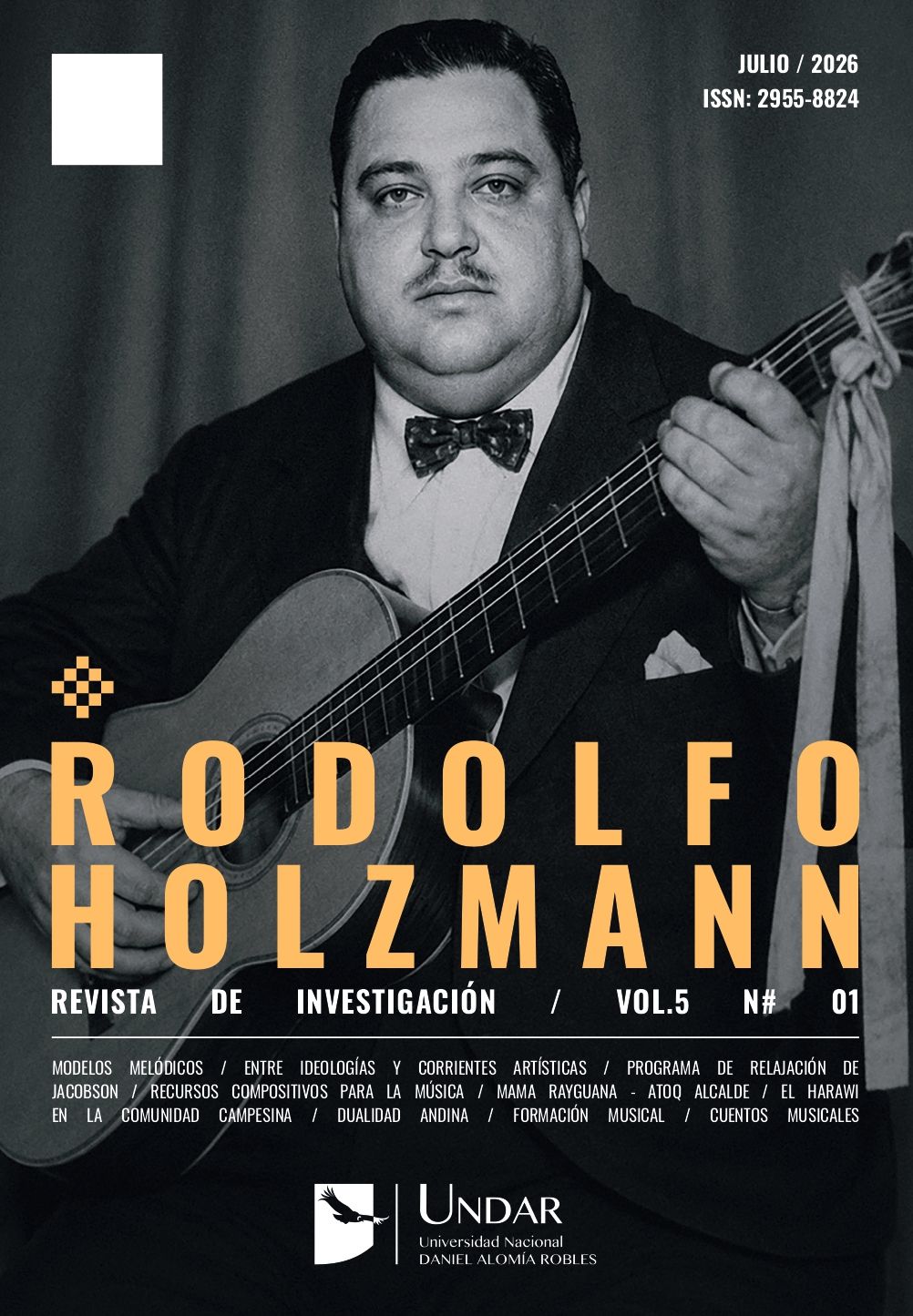
As it reaches its fifth year of publication, the Revista de Investigación Rodolfo Holzmann reaffirms its commitment to serving as an open forum for reflection, discussion, and knowledge production on the sonic and musical arts, thereby contributing to the development of research cultures in Peru. It is no coincidence that this project originated in Huánuco, a region that has occupied a significant place in Peru’s musical history and was the birthplace and creative setting of such foundational figures as Daniel Alomía Robles and Rodolfo Holzmann. Within these traditions lies a way of perceiving and experiencing music that extends beyond artistic creation to encompass the need to know, understand, study, and transmit it. It is in this legacy—and in the enduring appreciation of and engagement with musics and the knowledge they generate—that we find part of the journal’s raison d’être.
We envision this journal as a space for encounter, one capable of welcoming diverse voices and participating in the conversations currently shaping the sonic arts, while building bridges between our own traditions and the multiple paths pursued by music research in other contexts. This endeavor is necessarily collective and requires continuity, exchange, and openness to new questions, methodologies, and forms of knowledge. The Revista de Investigación Rodolfo Holzmann thus aspires to continue along this path from Huánuco, carrying forward a tradition that looks to its own history while simultaneously opening itself to Peru and the wider world.
Downloads
Author Biography
-
José Ignacio López Ramírez Gastón, Universidad Nacional Daniel Alomía Robles

PhD and an MA in Computer Music from the University of California, San Diego, and a BA in Arts with a specialization in Religious Studies from The Ohio State University. As a researcher, educator, and sound artist, his work focuses on electroacoustic music, sound art, technology, culture, and popular music studies. He has presented research in Peru and internationally on listening practices, electronic experimentation, and jazz. He currently coordinates the Directorate of Innovation and Technology Transfer and the Electroacoustic Music and Sound Art Laboratory at the Universidad Nacional de Música and is a researcher at the Institute of Ethnomusicology.
Published
Issue
Section
License
Copyright (c) 2026 José Ignacio López Ramírez Gastón (Autor/a)

This work is licensed under a Creative Commons Attribution-NonCommercial-ShareAlike 4.0 International License.
Los conceptos contenidos en los artículos científicos incluidos en esta edición, son de responsabilidad exclusiva de los autores y no reflejan necesariamente los criterios institucionales.
Los autores/as conservarán sus derechos de autor y garantizarán a la revista el derecho de primera publicación de su obra, el cuál estará simultáneamente sujeto a la licencia de Creative Commons Reconocimiento 4.0 Internacional.